
The mining of gold, a key component of Breitling’s luxury watches, is highly water-intensive and is totally dependent on supplies of groundwater and surface water. Water pollution can also be a highly material issue for gold mining.
This makes water stewardship essential for the company’s sustainability strategy and overall business resilience, and is just one of many insights derived from its industry-leading state of nature assessment.
Breitling is a luxury watchmaker based in Switzerland, known for precision, innovation and style, with their timepieces enjoyed by aviation professionals, divers and watch enthusiasts around the world. Sustainability is very important to Breitling’s corporate values, and they pride themselves on being leaders in corporate sustainability.
I have worked closely with Breitling on several projects over the years, including its state of nature assessment in 2024. I really value the opportunity that comes with long-term client relationships to work collaboratively in partnership to deliver the best results.
Aurelia Figueroa, Chief Sustainability Officer at Breitling, says that she decided to work with me because “Hélène is a highly specialised, passionate and engaging expert on nature and climate” and “she delivers best-in-class assessments on which you can rely in taking business decisions. We appreciate how she quickly grasps what needs to be done and takes a pragmatic approach, often using public and open-source resources, to achieve the best results possible within the timeframe and budget.”
The challenge and motivation
Breitling leadership wanted to follow best practices on nature and biodiversity to align with their corporate values, inform their efforts with a science-based approach, and maintain their competitive edge as a frontrunner on sustainability.
Aurelia holds a strong conviction about the importance of nature, stating that: “Nature is, and always has been, core and central to every business, every activity on Earth. There is no exception to this fundamental principle at Breitling, and we remain committed to understanding our impacts and doing all we can to address these, informed by science-based principles.”
As this is an emerging area of best practice, there are many challenges around clearly identifying nature dependencies and impacts and integrating them into business practices.
The project
The key deliverables of the project:
- Heatmaps showing the company’s dependencies and impacts on nature
- Map of priority locations that are classed as ecologically sensitive, ready for further assessment
Breitling is an early adopter of the Taskforce on Nature-related Financial Disclosures (TNFD), a global initiative that supports companies and financial organisations in integrating nature into business strategies.
The TNFD uses the ‘LEAP framework’, which stands for:
- Locate your company’s interface with nature
- Evaluate your dependencies and impacts on nature
- Assess your risks and opportunities related to nature
- Prepare to respond and report
This project covered the initial ‘Locate’ phase of the LEAP approach, which involved analysis to screen and identify material impacts and dependencies on nature across the company’s value chain. 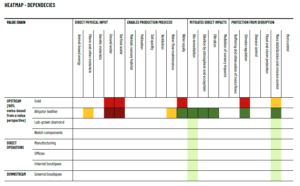

Breitling Sustainability Mission Report 2024, p73-74
The project also included sensitive location analysis, mapping locations within Breitling’s operations and supply chain that overlap with areas of high physical water risk, high biodiversity, protected habitats, and critical ecosystems.
For this, I worked with open-source tools and methodologies, including ENCORE and the SBTN Screening tool, the Ecoregions tool, Aqueduct Water Risk Atlas, IBAT and the WWF Risk Filter Suite. Using free tools means the budget could be spent on expert analysis and delivery instead of fancy software, reflecting my pragmatic and results-focused approach.

Breitling Sustainability Mission Report 2024, p75
The analysis highlighted the critical importance of water for Breitling’s supply chains. Locations identified as either ecologically sensitive or with material nature-related dependencies, impacts, risks, or opportunities are designated as priority locations, forming the basis for further work and TNFD-aligned disclosure.
Results and outcomes
This project resulted in relevant disclosures in Breitling’s 2024 Sustainability Mission Report — becoming the first in their industry to commit to adopting the TNFD and publish their first results — and more importantly, is informing their engagement along the supply chain to address these impacts.
It also paved the way for developing Breitling’s first nature targets. They plan to validate these with the Science Based Targets Network (SBTN), which I am pleased to continue advising on. This is a cutting-edge area of corporate sustainability, so Breitling will likely enjoy enhanced brand value from their leadership position.
The work also laid the foundations for a full nature risk analysis and for nature to be incorporated into the enterprise risk management system, along with climate risks.
Most importantly, the project led to the acknowledgement of the importance of nature for business resilience, and in particular, the prioritisation of water stewardship. Following this project, Breitling has now completed a full water footprint assessment for all of the identified priority locations, which is the next step towards more sustainable and resilient management of water supplies.